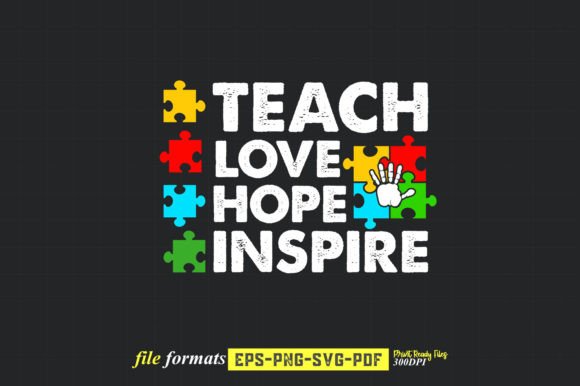
Reviewing the Teach Love Hope Inspire SVG for Embroidery
As a designer who has spent countless hours digitizing and stitching out various machine embroidery design files, I approach every new asset with a critical eye. It is not just about whether the graphic looks good on a screen; it is about how it translates to thread, how it behaves under the needle, and ultimately, how it resonates with the person receiving the finished product. Recently, I evaluated the Teach Love Hope Inspire Svg Design, a piece categorized under Crafts and Graphics, intended for uses ranging from autism awareness t-shirts to Valentine’s Day mugs. While the product description highlights its versatility for posters and stickers, my focus was strictly on its viability for textile applications.
First Impressions: Mood and Visual Personality
The immediate appeal of this design lies in its hand-drawn lettering style. In a market saturated with rigid, geometric fonts, the organic flow of the words "Teach," "Love," "Hope," and "Inspire" creates a warm, approachable mood. This is crucial for the intended themes of autism awareness and heartfelt gifting. The layout feels balanced, suggesting a design that was created with human touch rather than automated spacing. For an embroidery project, this organic nature is a double-edged sword. It offers charm, but it requires careful digitizing to ensure the irregular lines do not result in uneven stitch lengths or gaps.
When I first loaded the file into my viewing software, I looked for clean vector paths. Since this is marketed as a vector illustration suitable for various design assets, the underlying structure should be robust. However, converting a hand-drawn aesthetic into a stitch file means respecting the original intent while ensuring structural integrity. The visual personality suggests softness and encouragement, making it a natural fit for items meant to comfort or inspire, such as nursery decor or teacher appreciation gifts.
Real-World Application: The Custom Tote Bag Scenario
To truly test the potential of the Teach Love Hope Inspire Svg Design, I imagined a specific real-life scenario: creating a custom tote bag design for a local special education teacher. The goal was to produce a durable, meaningful personalized gift that could withstand daily use. I selected a heavy-weight canvas tote, which provides a stable surface for embroidery.
In this context, the design’s length works well across the center of the bag. The words stack or flow in a way that allows for a moderate hoop size, likely a 5x7 or 6x10 inch frame, depending on the specific arrangement chosen by the digitizer. Using a combination of satin stitch for the bolder strokes and running stitch for finer details could replicate the hand-drawn look effectively. The result would be a textured, tactile piece that elevates a simple canvas bag into a boutique-quality item. For an Etsy seller or small shop product creator, this kind of thoughtful application adds significant perceived value.
Performance on Different Fabrics and Garments
Versatility is often claimed but rarely delivered. Here is how I see this design performing across different mediums:
- Sweatshirt Embroidery: On fleece or cotton blends, the design needs adequate stabilizer support. The hand-drawn lines might get lost if the fabric is too plush. Using a cut-away stabilizer is essential to prevent puckering, especially since the text implies multiple color changes or dense areas.
- Baby Embroidery: For baby clothes, the softness of the message aligns perfectly with the product. However, one must be cautious with thread colors and stitch density. A lighter touch, perhaps using a single-color fill stitch or even an applique design technique where the text is stitched over a fabric patch, would reduce bulk and increase comfort against sensitive skin.
- Custom Apparel and Caps: Placing this on a curved surface like a cap requires careful hooping. The horizontal spread of the words might distort if the cap is not stabilized correctly. For t-shirts, a lightweight tear-away stabilizer might suffice, but testing on scrap fabric is non-negotiable to ensure the knit does not pucker around the letters.
Technical Considerations and Potential Pitfalls
While the aesthetic is strong, there are areas where the Teach Love Hope Inspire Svg Design requires careful handling. Hand-drawn lettering often includes thin connectors or sharp terminals. In embroidery, these can become weak points if the stitch count is too low or if the thread tension is off. Tiny lettering or intricate corners may not stitch out cleanly on smaller hoops or with lower-quality threads.
Furthermore, when working with dark fabrics, the contrast becomes critical. If the design relies on subtle shading or light pastel thread colors, it may disappear on navy or black textiles. I recommend testing the design in black and white mockups first to check for clarity. If the digital file does not specify stitch types, the user must decide whether to use satin columns for a smooth look or fill stitches for a more textured, painted appearance. Dense stitch areas should be minimized to prevent stiffness, particularly on garments that need frequent washing.
Enhancing Brand Consistency and Customer Trust
For creative entrepreneurs and craft business owners, consistency is key. Using a cohesive design like this across a product line—such as matching mugs, towels, and shirts—can strengthen brand identity. The message "Teach Love Hope Inspire" is evergreen, appealing not just to autism awareness but also to educators, parents, and healthcare workers. This broad appeal increases the potential for commercial embroidery sales.
However, professionalism in presentation matters. When listing this as a digital embroidery file or a finished item, high-quality printable mockup images are essential. Show the design on various fabric texture backgrounds to help buyers visualize the final result. Clear communication about the care instructions for the embroidered item builds customer trust. If the design is used for holiday embroidery or specific awareness months, timing your listings can significantly boost engagement.
Practical Notes for the Embroidery Designer
Before committing to a large production run or selling this as a custom apparel option, consider these practical steps:
- Test on Scrap Fabric: Always stitch out the design on the same type of fabric you intend to use for the final product. This reveals issues with tension, density, and registration.
- Check Thread Contrast: Ensure the chosen thread colors stand out against the background fabric. High contrast improves readability and visual impact.
- Review Stitch Density: If the file allows, adjust the density to suit the fabric weight. Heavier fabrics can handle denser stitches, while lightweight materials require a lighter touch.
- Confirm Licensing: The product description mentions various uses, but always verify the license terms for commercial use. Ensure you have the right to sell finished items or digital products derived from this design.
- Inspect Small Details: Zoom in on the vector file to check for any stray nodes or imperfect curves that might cause stitching errors.
In conclusion, the Teach Love Hope Inspire Svg Design offers a compelling blend of emotional resonance and aesthetic charm. While it originates as a graphic for print and digital media, its potential in the world of embroidery is significant. With careful attention to technical details like stabilizer choice, stitch type, and fabric compatibility, this design can transform simple textiles into meaningful, high-value keepsakes. For the discerning maker, it represents not just a pattern, but an opportunity to create connection through craft.